Published: October 28, 2026
The bins usually come home before the decision does. A weekend gets set aside for the garage, so the cart fills first: a stack of clear boxes, a set of drawer dividers, maybe a label maker. By Sunday night the boxes are full. What went into them is mostly what was already there, now with lids.
That is the quiet failure of organization products. They are very good at making things fit and no good at all at asking whether those things should stay. A bin cannot tell the difference between the holiday decorations you use every December and a tangle of chargers for phones you sold years ago. It holds both with the same calm.
Our pantry guide already says plainly that containers do not save money. That is true, and it is not the whole story either. A handful of purchases genuinely earn their price. This guide is about telling which ones, before you pay.
Key Takeaways
- Buy last. A product should hold something you have already decided to keep, in a space you have already measured. Bought first, bins tend to preserve the very clutter you meant to clear.
- The test is a problem, not a look. If you cannot name the specific thing it fixes — can’t find it, can’t reach it, it keeps falling over — it is a styling purchase. Fine to make, but not a saving.
- Usually worth it: dividers for small loose things, risers or turntables for deep shelves, hooks for things used every day, and a few clear bins for categories you genuinely rotate.
- Usually not: matching sets bought before sorting, single-purpose gadgets, and anything that makes it easier to keep what you were about to let go.
- The label maker is the cheap part of labeling. At the prices Brother listed when we checked in October 2026, its 12mm laminated tape works out to about 63 cents a foot — worth it for shared spaces and opaque bins, unnecessary almost everywhere else.
In short: sort first, measure second, name the problem third — and buy only what solves it.
| Product | Usually worth it when | Usually not worth it when |
|---|---|---|
| Drawer dividers | Small loose items keep migrating | The drawer is already overfull |
| Clear bins with lids | A category you rotate and need to see at a glance | Bought as a matching set before sorting |
| Shelf risers and turntables | Things vanish at the back of a deep shelf | The shelf is full to the front edge |
| Hooks and over-door racks | Daily-use things keep landing on a chair | Hanging up things nobody uses |
| Label maker | Shared spaces and opaque bins | A one-person drawer or a clear bin |
| Vacuum storage bags | Bulky bedding you will use next winter | Clothes you cannot decide about |
The Product Is Not the Problem. The Order Is.
In Apartment Therapy’s roundup of seven organizers’ biggest “don’ts”, not buying containers before you sort leads the list, and more than one organizer raises it. It reads like a tidiness rule. It is really a money rule.
Here is why. A bin bought before you sort gives every item it holds a home, and a home is the strongest argument there is for keeping something. The box of cables was on its way out. Then it got a lid, a shelf and a label, and now throwing it away feels like undoing work. The purchase did not just cost its price. It can change the decision.
Put a number on the visible part. IKEA listed its clear 6-gallon SAMLA box with a lid at $6.99 when we checked in October 2026. Ten of them is $69.90.
About $70 — ten clear 6-gallon boxes at the IKEA price we found in October 2026, bought before anyone has decided what goes in them.
Now say the sort sends a third of what was headed for those boxes out of the house. Buy after sorting and you need seven, not ten — about $21 you never spend. That is the small cost. The bigger risk is the leftover boxes, because an empty bin in a closet looks like a problem waiting to be solved, and the usual way to solve it is to fill it.
That is also why the order in our guide to what to declutter first starts with the things you are paying to keep. And every product in this article is, in the end, one more thing you buy in order to keep other things.
Five Questions to Ask Before You Buy Anything
1. Decide what stays before you buy anything to hold it.
This is the one rule every other rule depends on. Sort the space completely — keep, go, decide later — before the cart. If you are starting in the kitchen, our one-weekend kitchen declutter walks through what to pull first. Only the keep pile gets a product.
2. Name the problem in one sentence.
“We can never find the scissors.” “The pans fall out every time the cupboard opens.” “The kids cannot reach their own coats.” Each of those is a problem a specific product can fix, and each one tells you exactly which product. “It would look nicer” is not a problem. It is a perfectly good reason to buy something, as long as you file it under decorating, not saving.
3. Measure the shelf and the stuff that goes on it.
Depth, height, and the clearance the hinges, shelf lip and drawer slides actually leave. Then measure the things themselves. That SAMLA box is about 15¼ inches wide, 11 deep and 11 tall with its lid on — reasonable dimensions, and still worth checking against the shelf before ten of them come home. A product that almost fits tends to stay anyway and quietly change how the shelf works, usually for the worse.
4. Picture it on a bad week.
A system has to survive a tired Tuesday, not just a motivated Saturday. Lids that need two hands, stacks where the bin you need is always on the bottom, and folding methods that demand precision all fail the same way: the item ends up on top of the system instead of inside it. If putting something away takes more than one motion, it tends to end up on the counter.
5. Shop your house first — some of the organization products worth buying are already in it.
Shoeboxes make good drawer dividers. A basket from a gift holds the winter hats. The drawer insert from the dresser you are getting rid of can live in a desk. Spend a few minutes checking what the sort itself turned up before you buy anything to do the same job. Sometimes the empty containers are the best thing the sort produced.
To be fair to the aisle: the right product genuinely can change a habit. A hook by the door that ends the daily hunt for a backpack is worth far more than it costs. The point is not to buy nothing. It is to buy the one thing that solves a problem you can describe, and stop there.
What Usually Earns Its Price
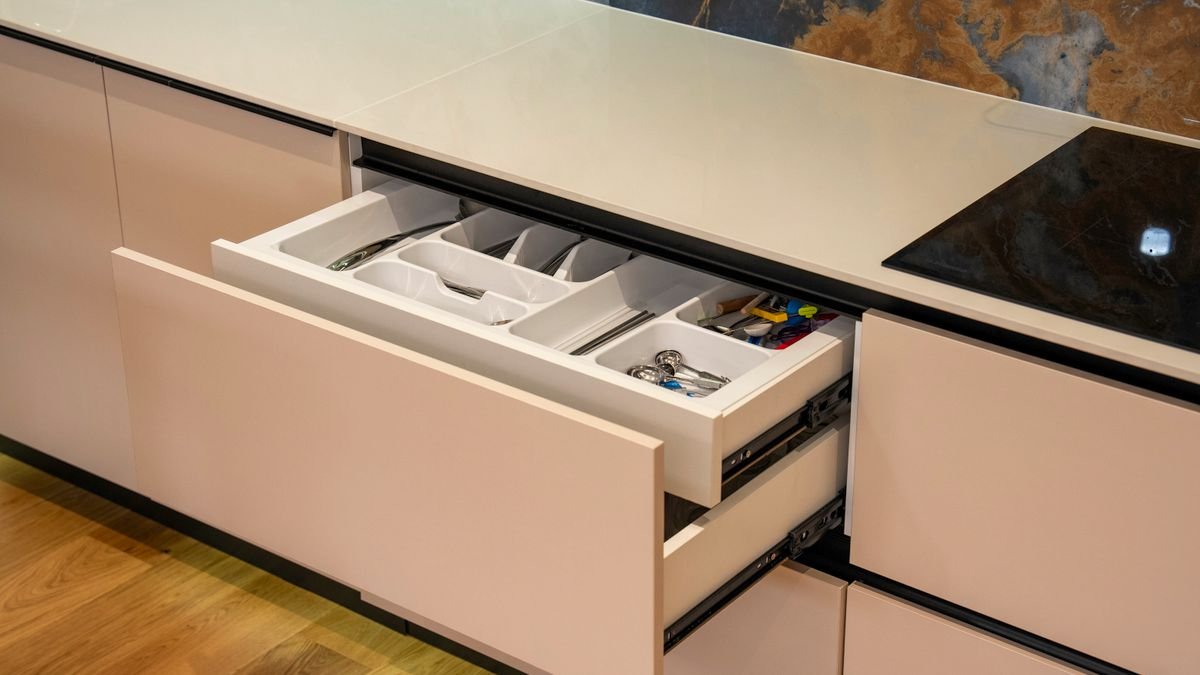
Dividers for small, loose things. Utensils, chargers, art supplies, socks, the junk drawer. Small items migrate; a divider stops them.
Risers and turntables for deep shelves. Anything that disappears at the back of a shelf is easier to overlook and buy twice, which is the leak our pantry guide is built around. A riser that puts the back row at eye level is one of the few organization purchases with a plausible path to spending less.
Hooks and over-door racks for things used every day. Coats, backpacks, leashes, the reusable shopping bags. If something currently lives on a chair, a hook is often the fix.
A few clear bins, for categories you rotate. Seasonal clothes, holiday decorations, sports gear between seasons. Clear matters, because you can see what you own without opening the lid — and what you can see, you are less likely to buy twice.
What Usually Does Not
Matching sets bought before sorting. The matching is the appeal and the trap: a set comes in sizes chosen for a photograph, not for your things.
Single-purpose gadgets. A dedicated rack for one kind of thing you own three of is a product that only works while nothing changes — and in a family home, something usually does.
Anything that makes keeping easier than deciding. Vacuum bags are a good example. For bulky bedding you will use next winter, they are a reasonable buy. For clothes you are storing because you cannot decide about them, they compress the decision along with the sweater, and it can stay compressed for years.
Decanting for its own sake. Pouring things out of their original packaging into matching jars is, as our pantry guide puts it, a styling choice — and it throws away the label that told you what something was and when it was best. Enjoy it if you like it. Just do not count it as savings.
The Label Maker, With the Numbers
Label makers are the product this whole category is photographed around, so it is worth doing the arithmetic. Brother listed its entry-level PT-H110 at $34.99 when we checked in October 2026. Batteries are not included — it takes six AAA — and it ships with a 13.1-foot sample tape.
The sample runs out. A replacement cartridge of Brother’s 12mm (about half-inch) black-on-white laminated tape lists at $16.49 for 26.2 feet.
About 63 cents a foot — Brother’s list price for its 12mm black-on-white laminated tape when we checked in October 2026, $16.49 for a 26.2-foot cartridge.
Measured in three-inch strips, the sample holds about 52 labels and each replacement cartridge about 105, at roughly 16 cents of tape a label. None of that is expensive. But it does mean the device is the cheap part. The tape is the running cost, and it only pays off where a label does real work.
That is a narrower list than the photos suggest. A label earns its place in shared spaces — a garage, a linen closet, a kids’ room — where someone other than you has to find things and put them back. It earns it on opaque bins, where you cannot see the contents. It does not earn much on a clear bin whose contents show at a glance, or a drawer only one person uses. And where you do label, label the shelf rather than the container, as the pantry guide suggests: the label survives a change of contents. A strip of masking tape and a marker does the same job for free.
What the “Calm Home” Research Actually Says
Much of the appeal of organization products is a feeling: a home that finally feels finished. There is research connecting how people describe their homes with mood and cortisol patterns, but it says something narrower than the popular claim that clutter simply raises your stress hormones.
One study often cited for that claim is Saxbe and Repetti, published in 2010 in Personality and Social Psychology Bulletin. It did not count bins or measure clutter. Researchers analyzed the words 60 dual-income spouses used on self-guided tours of their own homes — how often they described clutter or the house as unfinished, compared with restful or nature words. Women whose tours leaned on the cluttered, unfinished language showed flatter cortisol slopes across the day and more depressed mood over the course of the day, after accounting for marital satisfaction and neuroticism.
So the study measured how people talked about their homes, not whether buying anything would change it. Still, one detail is worth keeping in mind before checkout: “unfinished” was part of the stressful language. A closet full of empty bins waiting for a weekend that has not happened yet is, almost by definition, an unfinished project.
More Worth Knowing
Keep receipts and packaging until the products are filled and the space works. Return windows differ by store, so check the policy before you buy rather than after — the cheapest organizing purchase is the one you return.
And the pile that did not make the cut is not automatically trash. Our guide to selling or donating what you declutter sorts out which items are worth the effort of listing and which are better dropped at a donation center on the way home.
Frequently Asked Questions
Should I buy storage bins before or after decluttering?
After. Sort the space completely, measure what is staying and the shelf it is going on, and only then buy containers for the keep pile. Bins bought first tend to fill with the things you meant to get rid of.
Is a label maker worth it?
For shared spaces and opaque bins, it can be. Brother’s entry-level PT-H110 listed at $34.99 and its 12mm laminated tape at about 63 cents a foot when we checked in October 2026. For clear bins, or spaces only one person uses, masking tape and a marker usually do the same job.
What organization products are actually worth buying?
Ones that solve a specific problem you can name in a sentence. Dividers for small loose items, risers or turntables for deep shelves, hooks for things used daily, and a few clear bins for categories you rotate are the purchases that most often earn their price.
Do organization products save money?
Directly, rarely. Indirectly, sometimes: when a product makes things visible enough that you stop buying duplicates, it can pay for itself. Otherwise, it is a cost like any other, and worth treating as one.
The Bottom Line
Organization products are good at exactly one thing: holding what you have already decided to keep, in a space you have measured, in a way you can live with on a bad week. Bought in that order, a few of them earn their price. Bought first, they mostly make clutter tidier.
So before anything goes in the cart, finish one sentence: “I am buying this because…” If the end of it is a problem you can name, buy it. If it is a picture of a room you would like to have, put it back and spend the afternoon sorting instead. That part is free.
Want more tips like these delivered to your inbox? Sign up below — you’ll also get our free grocery budget worksheet, and we only send stuff that’s actually useful.